all on 4 concept dentures what to expect
All-on-4 dental implants treatment is a surgical procedure that involves the rehabilitation of a completely edentulous jaw with only iv implants, and attaching a full-curvation stock-still prosthesis to these implants on the mean solar day of surgery. Edentulism is the condition of being toothless (complete or partial), which has a major impact on general and psychological wellness. Teeth make us look skilful when we grin or talk. They help us cut, grind, and chew the food. Also, teeth play a major part in the pronunciation of various sounds (s, z, j, x, d, n, l, t, f, 5, & th). Edentulism lowers the patients' quality of life, and makes them embarrassed when they smile, talk, or swallow, leading to decreased self-esteem.
Dental implants provide a solution for patients with a completely edentulous jaw. The dentist places eight implants in the upper jaw and half dozen implants in the lower jaw to support a total-arch fixed prosthesis. Nonetheless, this solution is expensive and not suitable for patients with moderate to astringent bone loss. So, a new solution is needed. At the terminate of the 1990s, Portuguese dentist Paulo Maló and the implant manufacturer Nobel Biocare developed the All-on-4 dental implants concept, which is a fast, price-effective alternative to conventional implant techniques. In this article, we will discuss:
- What is a dental implant?
- Conventional implant technique vs. All-on-four.
- All-on-4 step past step.
- What to expect after the process?
- Postal service-operative instructions.
What is a Dental Implant?
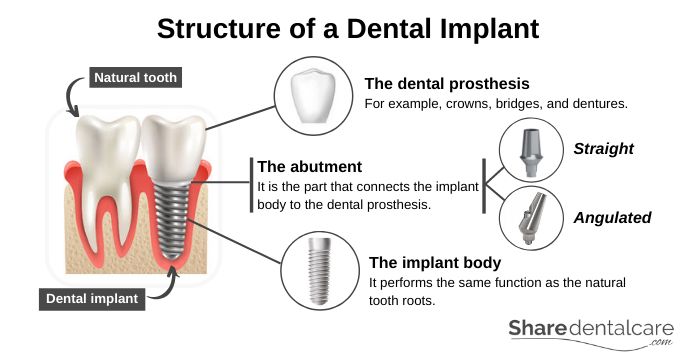
To fully empathise the All-on-4 dental implants concept, y'all should starting time know what a dental implant is. The implant is an artificial tooth root that is surgically placed into the jawbone below the gum line to replace a missing molar/teeth. The jawbone fuses with the implant (osseointegration), providing stable back up for a dental prosthesis such every bit a crown, bridge, or denture. A conventional dental implant consists of:
- The implant-trunk: it looks similar a screw and is fabricated of titanium or zirconia. The implant-body function is to provide support for a dental prosthesis. The dentist places the implant-torso into the jawbone. After that, the bone grows and fuses with implant-body (osseointegration), which can take from 4 to 6 months.
- The abutment: it connects the implant-trunk to the dental prosthesis. The abutment tin can be straight or angulated.
- The dental prosthesis: the implant-supported prosthesis tin can exist categorized into:
- A fixed prosthesis such equally crown and bridge.
- A removable prosthesis such as a denture.
What is the All-On-4 Dental Implants?
The All-on-4 dental implants treatment is a surgical, prosthodontic procedure that involves the rehabilitation of an edentulous jaw by placing iv implants just. These iv implants back up a total-arch prosthesis, which contains ten to fourteen artificial teeth. The All-on-4 is suitable for patients who take an edentulous jaw with or without remnant hopeless teeth. Too, All-on-4 dental implants treatment is best for patients who take jawbone loss that prevents them from getting dental implants by using conventional techniques.
Conventional Dental Implant Technique
Conventionally, to back up a full-arch fixed prosthesis in an edentulous jaw, you will need at least eight implants in the upper jaw and six implants in the lower jaw. Also, you may need a bone graft if the jawbone is sparse, soft, or insufficient to create a more than solid base for the implants. Afterward the placement of the implants, you won't receive whatever prosthesis until the osseointegration is complete (delayed loading of the implants). Because attaching the prosthesis to the implants during the healing period (osseointegration) can crusade implant movement and failure. Sometimes, the dental implant is contraindicated because the jawbone is insufficient or/and the anatomical structures such as maxillary sinuses or fretfulness are also shut. Note: osseointegration is the fusion betwixt the jawbone and the implant, which tin can have from three to six months.
All-On-4 Dental Implants Concept
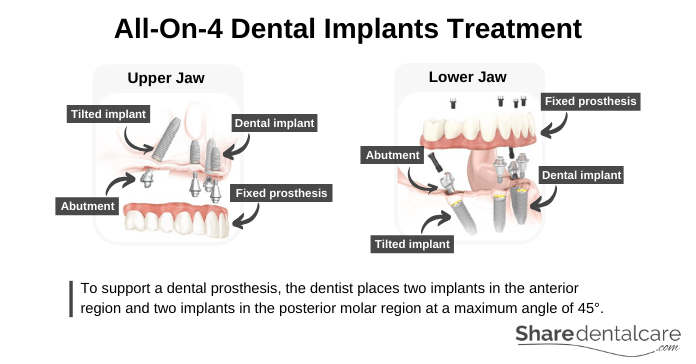
While in the All-on-4 dental implants, you will demand 4 implants only to support a total-curvation fixed prosthesis. Your dentist will insert two implants in the anterior region (the place of lateral incisors) and two implants in the posterior molar region at a maximum bending of 45°. The All-on-iv dental implants treatment takes advantage of the dense bone in the anterior region. Besides, placing the posterior implants at an angle makes the implant secure and stable, which usually eliminates the need for a bone graft (graft-less procedure). Often, you volition receive a provisional fixed prosthesis on the day of the surgery (immediate loading of the implants), which you will wear during the healing menstruum (osseointegration). The All-on-iv is usually best for patients with close anatomical structures such as maxillary sinuses and fretfulness because tilting the posterior implants helps avoid the anatomical structures.
Advantages of All-On-4
- Fewer implants, less cost (cost-constructive solution).
- Suitable for patients with a thin or narrow jawbone. No need for a bone graft (graft-less procedure).
- Suitable for patients with close anatomical structures such every bit maxillary sinuses and nerves.
- Yous can receive a conditional fixed prosthesis on the day of the surgery (immediate loading of the implants).
- It supports a fixed prosthesis, which is:
- Meliorate in aesthetics and chewing function than a removable prosthesis.
- More comfortable than a removable prosthesis.
Disadvantages of All-On-4
- College load on the inclined implants.
- Possible problems due to the immediate loading of the implants.
- The provisional prosthesis volition increase the full cost of the process.
Is the All-On-four Dental Implants Suitable for All Patients?
Generally, All-on-iv dental implants treatment is suitable for patients with a completely edentulous jaw, peculiarly if they:
- Have a thin or narrow jawbone.
- Have close anatomical structures such equally maxillary sinuses and nerves.
- Looking for a cost-effective culling to conventional implant techniques.
- Desire a provisional prosthesis on the solar day of the surgery (firsthand part).
- Want a permanent fixed prosthesis.
Y'all can talk to your dentist to run across if the All-on-4 dental implants treatment is the right pick for you.
Contraindications
Usually, dental implants are suitable for patients with a missing tooth/teeth. Still, they are contraindicated in the following cases:
- During pregnancy.
- Patients younger than 18 years former.
- Heavy smokers.
- Alcoholism and drug abuse.
- Patients receiving radiotherapy or chemotherapy.
- Medical conditions that bear on the healing procedure:
- Uncontrolled diabetes mellitus.
- Bleeding disorders.
- Immune suppressive disorders.
- Bone disorders such every bit Paget'south disease.
You lot need to visit your dentist to run into if the dental implants are suitable for you because every patient needs to be evaluated on an individual basis.
All-On-4 Dental Implants Procedure (Stride-by-Stride)
Pre-Operative Planning
The pre-operative planning is necessary for the success of the All-on-iv dental implants procedure. So, your dentist will:
- Review your medical history: some medical conditions such as diabetes mellitus and bone disorders tin affect the healing process, causing implant-failure. And then, tell your dentist about previous and existing medical conditions and any medications you accept to prevent complications.
- Examine your mouth: your dentist volition examine your mouth with a mirror and probe and take a dental impression to make a report model. Also, your dentist volition ask for a 3D x-ray (cone axle computed tomography CBCT). The CBCT provides accurate information near:
- The quality and quantity of bone.
- The location of anatomical structures such as maxillary sinuses and nerves.
- Brand a treatment programme: the dentist will utilise your study model and CBCT to brand a treatment plan, which includes:
- The extraction of remaining and damaged teeth.
- Planning the exact position and angulation of the implants.
- Making a surgical guide for precise implant insertion.
- The prefabrication of a provisional prosthesis for attaching it immediately later the surgery (immediate role).
- Determining the type of final prosthesis.
Anesthesia
The all-on-4 dental implants procedure is oral-surgery. And so, y'all will need anesthesia to feel comfortable during the procedure. The anesthesia options include:
- Local anesthesia: often, the dentist uses local anesthesia for the placement of the implants. Local anesthesia won't interfere with your state of alacrity, and you will exist awake during the procedure.
- Conscious sedation: your dentist may offer local anesthesia in combination with conscious sedation to assistance you reduce anxiety and discomfort during the procedure. It volition produce a dream similar-state and make you feel relaxed. Conscious sedation is beneficial for patients with extreme dental anxiety. Y'all may receive the medication used in conscious sedation through:
- Oral tablets.
- Intramuscular injection (IM).
- An intravenous line (Iv).
- Inhalation (nitrous oxide).
- General Anesthesia: under full general anesthesia, you will be completely unconscious and won't remember or feel anything that is occurring during the procedure.
Visit your dentist to discuss which anesthesia selection is suitable for you.
The Placement Surgery
The dentist or oral surgeon performs the All-on-4 dental implants treatment in two ways:
- Conventional surgery (with flap).
- Flapless surgery (flapless approach).
Conventional Surgery (with Flap)
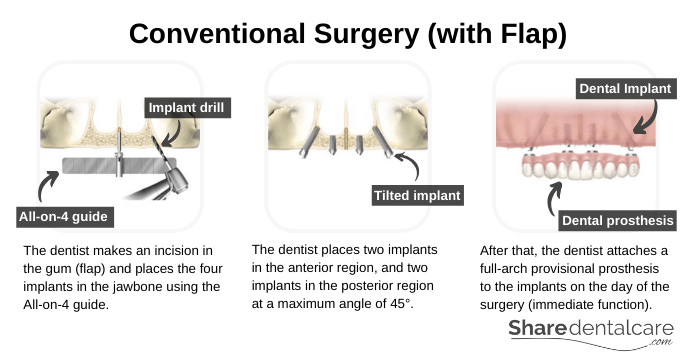
First, your dentist will use a scalpel to make an incision in the gum (flap) and expose the jawbone underneath. So, your dentist will place the 4 implants in the jawbone using the All-on-four guide. The dentist will place two implants in the posterior region at a maximum bending of 45°, and two implants in the inductive region (in the place of lateral incisors). Later on that, your dentist will suture back the flap and connect the abutments to the implants. After suturing, the dentist volition adhere a provisional stock-still prosthesis to the implants (immediate loading of the implants). You lot will receive the final prosthesis after a sufficient healing period. Sometimes, your dentist may recommend a conventional healing period earlier receiving a conditional or final prosthesis (delayed loading of the implants).
Guided Surgery (Flapless Approach)
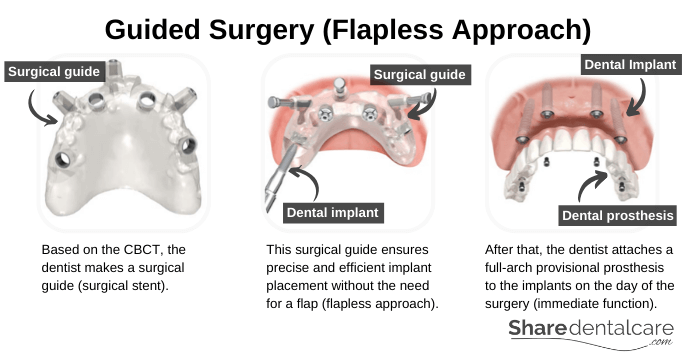
The dentist or surgeon will employ your cone-beam computed tomography (CBCT) and special software to plan the exact position and angulation of the implants near. Then, the surgeon will send this planned CBCT to the dental laboratory for the fabrication of a custom-designed surgical guide. This surgical guide ensures precise and efficient implant placement without the need for a flap (flapless arroyo). After the placement of the implants with the surgical guide, the dentist will adhere the abutments and conditional prosthesis to the implants on the day of the surgery (immediate loading of the implants). Sometimes, your dentist may recommend a conventional healing time before attaching a provisional or final prosthesis to the implants (delayed loading).
The guided implant placement surgery is a minimally invasive technique, which minimizes the hazard of pain and swelling, and ensures accurate, safe, predictable implants placement. However, it will increase the total cost of the process.
Healing Time
Later on the placement of the implants in the jawbone, the bone begins to abound and fuses with the implants (osseointegration). This process tin take from 3 to six months, depending on the quality of the os. Usually, you will receive a provisional fixed prosthesis on the day of the surgery (firsthand loading) to wear during the healing period. After the osseointegration is consummate, you will receive the concluding prosthesis. Sometimes, the dentist or surgeon recommends delayed loading protocol, which means that you won't receive a provisional or final prosthesis until osseointegration is complete.
The Dental Prosthesis
The Provisional Prosthesis
On the 24-hour interval of the surgery, you lot may receive a provisional all-acrylic span, to habiliment during the healing period. Sometimes, the dentist converts an existing denture into a provisional bridge. The all-acrylic bridge is not suitable as a long-term prosthesis considering of its weak resistance and immovability.
The Terminal prosthesis
The All-on-iv terminal prosthesis is highly esthetic and bachelor in dissimilar material options:
- Acrylic teeth and gingiva over a titanium framework.
- Composite veneered over a titanium framework.
- Porcelain crowns cemented on a metal framework.
Both acrylic and blended look similar to natural teeth and are economic options. Porcelain is a more expensive, popular, and superior option. Porcelain looks identical like natural teeth and is more than durable than acrylic and composite.
What to Wait Later the All-On-four Dental Implants Surgery?
Like any surgical procedure, yous may experience discomfort later the All-on-4 dental implants surgery. Then, your dentist will prescribe painkillers to aid you command the pain after surgery. Too, you may experience:
- Swelling of your gums and/or face.
- Bruising of your gums and/or face up.
- Minor bleeding and hurting at the site of the surgery.
- Limited oral cavity opening.
These signs and symptoms are normal after the surgery, and you tin can command them by using painkillers and anti-inflammatory medications. Nevertheless, if these signs and symptoms get worse, you lot should visit your dentist or surgeon immediately.
Instructions Afterwards the All-On-4 Dental Implants Procedure
Before the surgery, enquire your dentist or surgeon about the steps of the process, the type of anesthesia suitable for you, and postoperative instructions. These instructions are similar to tooth extraction aftercare instructions.
On the Day of the Surgery (in the First 24 Hours)
- Have the prescribed painkillers and anti-inflammatory medications to control the hurting.
- Maintain adept oral hygiene past using a soft-bristled toothbrush.
- Avoid things that may disturb the claret clot and promote bleeding:
- Avoid hot foods and drinks.
- Don't spit or rinse your oral cavity.
- Avoid aspirin because it inhibits blood clotting.
- Don't touch the surgical site with your finger or tongue.
- Avoid lifting heavy objects and exercise.
- Use cold compresses (ice-packs) to your confront. This will assist reduce the swelling. Note: put a towel betwixt the water ice-pack and your face up to avoid water ice burn.
- Avoid smoking because it affects the healing procedure and increases the risk of implant failure.
- Proper nutrition is important for the healing procedure. So, you should:
- Consume soft, absurd foods such every bit mashed potatoes, eggs, and a milkshake.
- Avoid foods such as chips, popcorn, and nuts.
- Avoid booze drinking.
- Enquire a family unit fellow member or a friend to take you lot dwelling house after the surgery considering you lot may not be able to bulldoze.
Instructions Afterward the First 24 Hours
- Rinse your rima oris with warm salt water (half a teaspoon of salt to a cup of warm water).
- Or you tin can use a chlorhexidine mouthwash twice daily.
- Limit physical activities in the starting time 48 hours after the surgery, and avoid practise and lifting heavy objects to forestall postoperative bleeding.
- Don't smoke because smoking affects the healing process and tin cause implant failure.
- Contact your dentist if you take questions or issues.
Following these instructions volition help y'all speed the healing procedure and prevent complications.
Complications of the All-On-four Dental Implants Procedure
The All-on-4 dental implants handling has over 95% success rate. However, complications may occur like any surgical process.
Complications During the Surgery
There are always risks involved with whatsoever surgical procedure. The risks include:
- Infection at the surgical site.
- Injury to the nerve, which tin can atomic number 82 to numbness or tingling of the lip, tongue, and mentum.
- Injury to blood vessels, which can lead to excessive bleeding.
- Perforation of the maxillary sinus, which can lead to a sinus infection.
- Poor primary implant stability, which tin pb to implant failure.
Complications During the Healing Period (in the Starting time half-dozen Months)
Sometimes, the implant fails to integrate with the jawbone (failure of osseointegration), leading to implant mobility and failure. The failure of osseointegration may occur due to several factors such equally poor oral hygiene, smoking, uncontrolled diabetes, and poor primary stability during the surgery.
Long-Term Complications
In some cases, a destructive inflammatory process may touch on the bone surrounding the implants, causing os loss. This condition is known as peri-implantitis, which may occur due to poor oral hygiene, smoking, bruxism, gum affliction, and uncontrolled diabetes.
Conclusion
Do you lot have an edentulous jaw? Are you looking for a cost-effective culling to the conventional implant technique? All-on-4 dental implants could be a suitable option for y'all. Conventionally, the dentist places 8 implants in the upper jaw and six implants in the lower jaw to support a full-arch bridge. While in the All-on-4, the dentist places four implants only per jaw to support a full-curvation bridge. Fewer implants mean less cost. Also, the All-on-4 is suitable for edentulous patients with minimum jawbone book considering the dentist places the posterior implants at an bending, which makes them secure and stable. Visit your dentist to know if the All-on-4 is suitable for you lot, how the procedure is performed, and what is the cost of the process.
brockcoutiquather1976.blogspot.com
Source: https://sharedentalcare.com/all-on-4-dental-implants/

Postar um comentário for "all on 4 concept dentures what to expect"